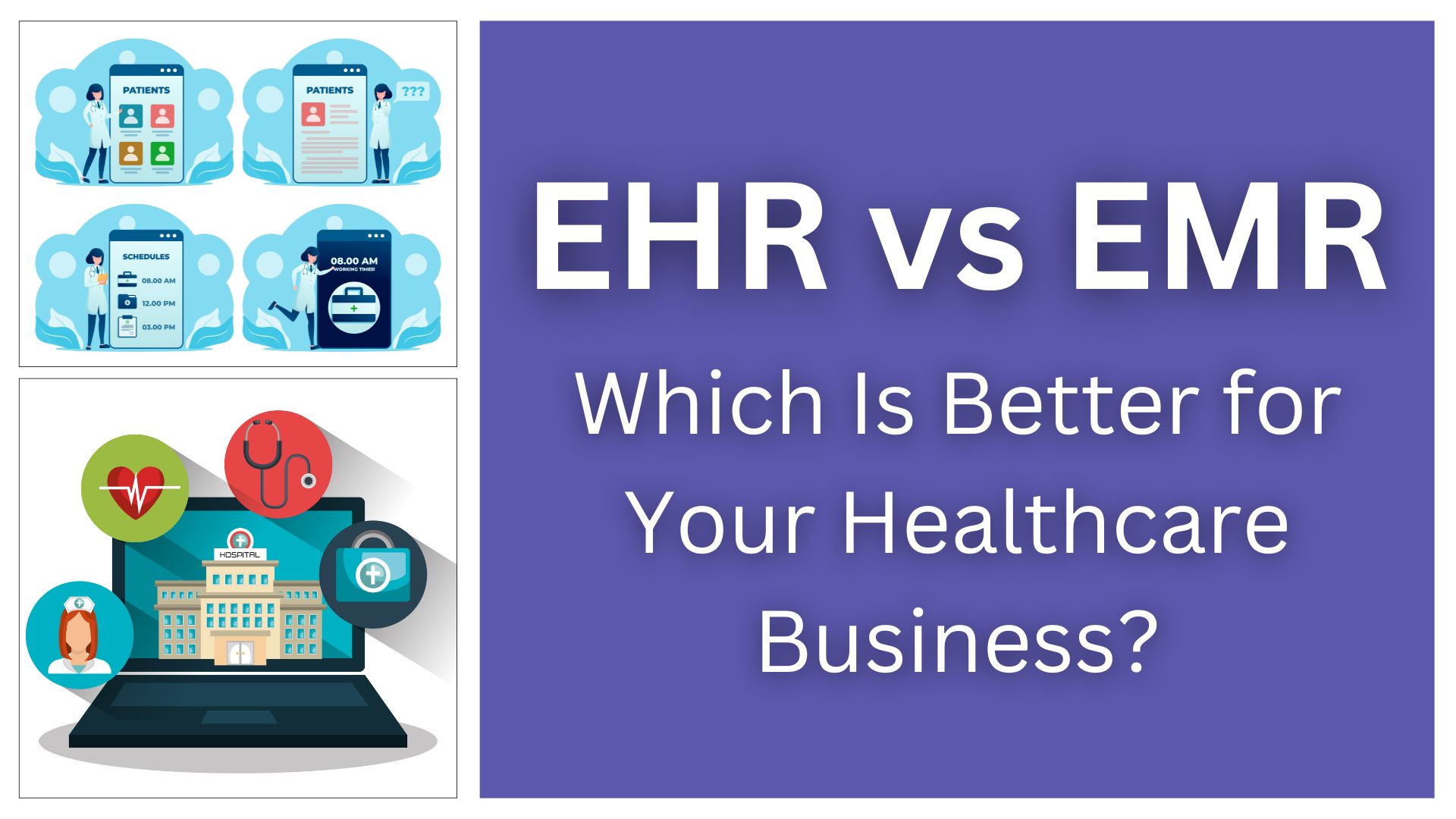
EHR vs EMR Difference: Which is Better for Your Healthcare Business?

For any healthcare organization operating today to provide the best care to patients and individuals across age groups, using electronic recording systems is not just a luxury but a necessity. The two main types are EHR (Electronic Health Records) and EMR (Electronic Medical Records) systems. This blog explores the EHR vs EMR difference comprehensively so that you, as a healthcare business, can understand which is better and more appropriately suited for your end-user needs. Although these two terms are used interchangeably, they vary significantly in their fundamentals. While both healthcare software systems can be used to securely store patient information, they serve different healthcare needs.
What is an EMR (Electronic Medical Records) System?
An EMR system refers to the digital version of health records that are stored manually in physical paper. Along with the medical and treatment history of a patient, they have the associated records of a single practice/practitioner/healthcare provider that is responsible for the overall medical management of the patient.
Key Features of an EMR Software
- Patient Health Data Management.
- Remote Patient Monitoring.
- Predictive Diagnostics.
- Custom Health Reporting.
- Appointment Management.
- Billing and Insurance Management.
- Data Interoperability within departments of a single healthcare practice.
- E-prescription Management.
- Vaccination Management.
EMR Use Cases for Small Clinics & Private Practices
- Improve Patient Care through better coordination and communication between the patient and their healthcare provider.
- Reduction of errors in patient data by overcoming the need for physical hand-written notes and boosting accuracy and readability through limited or no paperwork.
- Maximize the efficiency of your practice by automating key administrative aspects like appointment scheduling, documentation management, billing, and insurance.
- Generate custom reports to improve patient initiatives, identify critical trends in individual health, and facilitate precision-driven research efforts.
What is an EHR (Electronic Health Records) System?
An EHR system is also responsible for maintaining the health records of a patient digitally. But the key fundamental differentiator is that they can store a patient’s entire medical history across a wide range of healthcare providers. They bring together the medical and treatment history of a patient under a single umbrella from diverse practices with which the patient has consulted in the past.
Key Features of an EHR System
- Comprehensive health records management.
- E-prescriptions.
- Patient Portal.
- Billing and Insurance Management.
- Reporting and Data Analytics.
- Workflow templates.
- Interoperability amongst various healthcare providers.
- Pharmacy Management.
- Patient Engagement.
- Appointment scheduling.
- Remote Patient Monitoring.
EHR Use Cases for Hospitals & Large Healthcare Networks
- Improve coordination and communication between multiple healthcare providers related to the seamless flow of patient health records. Facilitate real-time patient data transfer through secure channels.
- Reduce errors in your medical practice and effectively diagnose patients through real-time alerts for patient health aspects.
- Increase the efficiency of your healthcare business by automating complex and multi-layered documentation processes, improving productivity, and enabling providers to streamline attention towards patient care.
- Improve Patient Engagement through custom-made patient portals, streamlined appointment scheduling, and frictionless communication between the patient and various healthcare providers.
- Maximize security and privacy of patient data through advanced methods like encryption, multi-role access controls, multi-factor authentication, and much more.
EMR vs EHR for Healthcare Business: Key Differences Explained
Understanding the fundamental and major EHR vs EMR difference will enable you to choose one of the best-fit healthcare software systems for your business and end-user needs. Let’s understand the core differences between EMR and EHR software systems in terms of business-critical aspects.
Data Sharing & Interoperability
When it comes to data sharing for EMR and EHR software systems, an EMR system is limited to just a single clinic, hospital, or healthcare practice. On the other hand, an EHR system is custom-tailored to enable seamless data transfer between multiple healthcare practices.
Similarly, in terms of interoperability, an EMR system cannot facilitate seamless patient data transfer to other locations or healthcare facilities. But an EHR system enables easy and frictionless data transfer between a wide range of healthcare providers and facilities.
Scalability & Multi-Location Support
In terms of scalability and location-support for EMR vs EHR for healthcare business, EMR systems don’t have access to provide multi-location support as they are confined to just a single practice. Also, the scope of scalability is limited and gets capped once you reach a certain threshold of patients your individual practice can cater to. On the other hand, EHR systems provide multi-location support as they facilitate patient data sharing between multiple healthcare providers and have a tremendous scope of scalability depending on the patient engagement needs.
Compliance & Security: HIPAA Compliant EHR & EMR Software Development
When engaging in either EHR or EMR development, both of these areas must adhere to HIPAA or any other relevant and applicable regulatory framework. The restrictions for adherence are a bit relaxed for building an EMR software system, but in the case of building an EHR, regulatory adherence requirements are stricter.
Patient Engagement Capabilities
When choosing between EHR and EMR software for patient engagement, the key differentiator is the functionality of patient portals. EMR software doesn’t generally have a patient portal module, which facilitates limited patient engagement capabilities. While EHR systems always have a dedicated patient portal section, which significantly boosts patient engagement through content resources, easy access to patients to see their own health records, and various learning modules.
EHR vs EMR Comparison: Summary
| Comparison Aspect | EMR Software | EHR Software |
| Applicability | Single Practice | Across a wide range of healthcare providers |
| Data Sharing | Limited to a single practice | Built for seamless data transfer amongst multiple healthcare providers |
| Interoperability | Low | High |
| Scalability and Multi-location Support | Limited | Maximum |
| Compliance Adherence | High | Very High |
| Patient Engagement | Limited | Maximum |
| Primarily Used for | Patient Diagnostics and Treatment associated with a single provider | Comprehensive patient health management across providers |
Not Sure Whether EHR or EMR Suits Your Business?
Talk to Our Healthcare Software Experts for a Free Consultation.
EHR vs EMR Cost Difference: Understanding the Financial Aspect
When it comes to building healthcare applications like EHR vs EMR for healthcare startups and established enterprises, understanding the cost and related financials to develop one becomes extremely crucial for any business in the medical and health industry.
You need to understand which core factors determine the overall EHR software cost vs EMR software cost in real-world scenarios so that you can adequately manage your technology investments for building a profitable healthcare business.
Top Factors Determining EHR vs EMR Cost Difference
- Firstly, total features needed and the overall complexity of the system. Building an MVP costs less than developing a full-fledged system.
- Furthermore, location of the healthcare software development team. Hiring a team in the USA may cost you more than hiring outside the country.
- Deployment solutions that can vary between on-premise, cloud, or hybrid methodologies.
- Extent of customization needed. Do you need to build one from scratch or want an off-the-shelf solution?
- Degree of adherence required to regulatory compliances like HIPAA, HITECH, GDPR, and many more. The more security measures you need to implement, the higher the total end cost.
- Support and maintenance assistance needed on an ongoing basis, which may include aspects like training your staff, licensing costs, quality assurance, system updates, modernization, and more.
EMR Implementation Cost
The overall cost to develop an EMR software system is low in comparison to an EHR because it’s made for a single practice or healthcare provider. Therefore, the overall complexity is less, and the total cost investment will be on the lower side.
EHR Implementation Cost
On the other hand, the total cost to build a custom EHR system is on the higher side as compared to an EMR because it’s made to integrate multiple practices associated with a patient to enable seamless data transfer and boost patient engagement through custom modules.
EHR vs EMR Comparison of Long-Term Cost ROI
| Aspect | EMR (Electronic Medical Record) | EHR (Electronic Health Record) |
| Initial Cost | Lower. Best for small practices | Higher. Need significant investment |
| Long-Term Impact | Moderate. You gain a lot from digitizing paper records management. | High. Maximize the productivity and efficiency of your practice significantly. |
Want to Get a Cost Estimate for Your EMR or EHR Software Project?
Get in Touch with Our Experts for a Personalized Consultation.
EHR vs EMR: Which is Better for Your Healthcare Business?
Firstly, I hope till this point you have understood the core EHR vs EMR difference and why you need to build one. Moreover, moving forward, here’s the summary of the two regarding which is best suited for your healthcare business.
Best Choice for Clinics & Small Practices
So, an EMR software system is best suited for small clinics and independent practices. It’s because these types of businesses have a limited need for data sharing, and building an EMR solution is a cost-effective option. Also, the interoperability requirements are minimal, implementation is simpler, and the cost investment is on the lower side.
Best Choice for Hospitals & Enterprises
Furthermore, an EHR system is perfect for a large healthcare organization like a hospital chain or a custom enterprise business in personalized care for individuals. They have a very high demand for patient health information sharing between providers, need to facilitate higher patient engagement, have higher interoperability needs, and the time and cost needed to build one is on the higher side as the complexity is higher, which demands the need of specialized and experienced team.
Decision Checklist for Healthcare Owners
- Project complexity
- Scope applicability
- Team size and expertise needed
- Interoperability requirements
- Data Sharing
- Customization level
- Business size
- Team location
- Features needed
- Deployments solutions
- Regulatory adherence needed
- Extent of support and maintenance assistance
Custom EMR and EHR Software Development: A Smarter Business Solution
Building a totally customized EMR/EHR solution for your business needs will be the best decision you can make for your end users because not only does it help you level up your healthcare organization in your unique way, but it also helps you maximize productivity and efficiency significantly as compared to building a ready-to-go off-the-shelf application.
Limitations of Off-the-Shelf EMR/EHR Software
- Rigid Workflow Incompatibility
- Poor Interoperability
- Limited scope of Customization
- High Costs & Hidden Fees
- Less refined User Experience
- Challenges with Scalability
- Safety and Compliance Risks
Benefits of Custom EHR & EMR Software Development
- Fully customized Functionality & Workflows
- Higher efficiency and productivity
- Maximized security and compliance with regulatory frameworks
- Higher scalability potential
- Improved patient care
- Future-proof software
- Best Interoperability
- Competitive advantage in the market
Integration With Existing Healthcare Systems
Building a fully personalized EMR or EHR application enables you to integrate it seamlessly with your existing healthcare software technology ecosystem through custom APIs without any hassle or friction. This facilitates better operational efficiency of your healthtech ecosystem rather than operating all the apps and modules in silos.
Why Choose a Professional EHR & EMR Development Company?
Partnering with an experienced and highly professional EHR & EMR software development partner not just maximizes your chances of business success, but also helps you in finding a reliable technology team that can act as your business’s backbone in building and maintaining your healthtech ecosystem.
Compliance-First Development
Firstly, a professional healthcare software development company will always adhere to compliance-first application development to ensure maximum patient data security and privacy.
Scalable & Secure Architecture
Moreover, an experienced EMR/EHR development company will always build a scalable and highly secure application based on the foundation of a modern software architecture. The team will help you build a future-proof application that grows as your business scales up.
Ongoing Support & Upgrades
Furthermore, a professional and experienced medical application development company that specializes in building custom EHR/EMR software solutions will always be there to assist you with regular software updates and upgrades, take care of all modernization needs, and ensure your app is free of all bugs and loopholes.
EHR vs EMR: Which is Better for Business Growth? (Final Verdict)
Picking the right option between an EMR and EHR software to build for your healthcare business needs is a crucial process. While both of them help in digitizing patient health records, you need to understand the relevant applicability and significance of each of them.
Go for building a custom EMR system if you have a small healthcare business or an independent practice that wants to digitize patient records effortlessly in line with your unique workflows. On the other hand, develop a custom EHR system if you have a large healthcare organization where the core necessity is to facilitate patient data sharing between multiple healthcare providers.
If you are still confused about which one is the right fit for your business needs, you can always partner up with a highly experienced healthcare software development company such as ChromeInfo Technologies. With more than 14 years of experience in building custom EHR and EMR solutions for small, mid, and large-scale businesses, we provide end-to-end assistance in comprehensive healthcare application development so that you can revolutionize patient care in your unique way.
Looking to Build, Upgrade, or Migrate Your EMR/EHR System?
Frequently Asked Questions (FAQs)
How much does it cost to build a custom EHR/EMR Software?
The costing for building a custom EHR/EMR app depends on factors like project complexity, total functionalities needed, team size and experience, level of regulatory compliance, team location, and level of customization needed.
What to look for in a software partner for EMR/EHR development?
Always look for their experience, projects completed, testimonials, reviews, and how they help you in building a personalized roadmap to bring your EHR/EMR software idea to real life product.
Should I build an EMR or EHR Software application for my Business?
If you are a small practice or an independent practitioner, go with building an EMR software. On the other hand, if you are a large hospital chain or enterprise healthcare business, build a custom EHR application.
What are the Key Regulatory Frameworks for EHR/EMR Software?
ISO, HL7, HIPAA, FHIR, HiTECH, GDPR, FDA, and DICOM are some of the common frameworks around which EMR and EHR software applications are developed.
How to do EMR to EHR Migration?
For legacy EMR system upgrade to EHR, you should always partner with an experienced healthcare software development company such as ChromeInfotech. We have more than a decade of experience in migrating and upgrading EMR systems to EHR solutions based on the custom needs of healthcare businesses.